Category: Pubs

  • Tom Kennedy’s: Thomas St.

    Tom Kennedy’s: Thomas St.

    Do you ever find that in our modern existence, where our surroundings are becoming more and more homogenised in the pursuit of commercialisation, you can lose touch with things of substance? – Things like history and culture! As you take a wander up Thomas St. and witness the encroaching trends of burrito and doughnut shops that pop up in identical guises to their sister outlets, it can become all too easy to forget just how old Dublin actually is.

    Tom Kennedy’s: Thomas St.

    Thankfully there are things that can reconnect us to our past, these can come in the guise of a grandmother shouting about cheap detergent on her metal stall, or for us they can come in the form of reading that a pub on this same street – namely Tom Kennedy’s, is one that is contained within a building that has had a presence upon Thomas Street since somewhere in or around the 1750s, an attribute that is put into context with ease when you consider that The Yanks only declared independence from The Brits in 1776.

    It’s said that Wolfe Tone may have been waked here in number 65 Thomas St, and if there’s any truth in that, it could be argued that this building has been accommodating functions for longer than most others in the city because when we arrived into the pub last we were greeted with banners and balloons aplenty denoting not that a revolutionary had been executed, but rather that Jessica was 21.

    Walking into this community-warmed local of a summer evening we found ourselves welcomed into the fold without the degree of scrutiny that you might find yourself under in some other shops – as we settled into a few high stools at the front of the bar we couldn’t but be charmed at how the place was abuzz with a warmth that felt akin to something from a Roddy Doyle novel.

    A long and narrow pub –it’s one that boasts all the character that a 260-year-old should. The seating is mostly cosy – long comfy couches sit you a short distance from the ground in a span that runs parallel to the bar. A handful of high stools sit toward the front of the room, ahead of those found at the bar, too.

    The walls leave no uncertainties as to the city within which you are drinking – framed images of all things Dublin are a recurring theme. Panelling coloured in creamy tones makes up the upper half of the wall space encountered upon entrance, and overall the pub is more brightly lit than is to our preference, but not to a degree that warrants any negative commentary on our part. Opening up toward the back, there is a raised section upon which sat a DJ who was blasting numerous ladies of the liberties with contemporary floor fillers as they loaded up on cocktail sausages.

    The pint is as is hoped for in these sorts of local boozers – having two of the modern Guinness drinker’s most sought-after features: creaminess and a price tag south of the fiver mark. We drank a couple, confirming the consistency too.

    There’s no real negative critique we could offer on Tom Kennedy’s here. We found an old article on a theliberty.ie from 2013 where the owner was expressing concerns about the future of the pub and lamenting the demise of other local ones that were shutting up shop back then. Five years on, we can only hope that he sees things a little more optimistically. The craic we had in here last summer would lead us to believe he should.

  • McGrattan’s: Fitzwilliam Lane

    McGrattan’s: Fitzwilliam Lane

    Sometimes, when a bit of research is warranted for pubs that we post, we can end up finding ourselves in some strange corners of the internet. Take this moment as an example – I’m currently perusing The Intoxicating Liquor Act of 1927 in order to identify the section of the act relating to The Holy Hour. All so I can corroborate a Brendan Behan quote in which he states that the politician who introduced The Holy Hour to the Dáil was shot dead an hour afterwards. As I type now, I’ve already realised that the link I was trying to establish between McGrattans’ proximity to the Dáil and a quote from a renowned drinker about politicians isn’t really there, or extremely tenuous at best.

    McGrattan’s: Fitzwilliam Lane

    Anyways, for those wondering, Kevin O Higgins – the politician responsible for the since-repealed weekly mid-day ban on the sale of alcohol was indeed shot dead, but the timing and motives suggested by Behan’s quote remain unproven.

    McGrattan’s is one of those boozers that you just can’t fault the placement of – tucked away and almost remote feeling, it lies down a laneway that’s a mere hop, skip and a jump from the various houses of government located upon Merrion St. Upper. The façade of the pub purports it to have been established in 1798, a claim that is reasonably denied in an article by the fantastic blog: Come Here To Me, which describes the premises as having been converted from a sheet metal workshop to a graduate club for the National University of Ireland in 1964 whereafter it traded as some form of bar up until it’s incarnation as McGrattan’s in 1989.

    The interior of the pub is unusual enough – two dissimilar atria are connected by a corridor furnished with pool tables, which acts as a buffer between the two. The front atrium is more bar than lounge and would be of the usual appearance seen around the city if not for its wallpaper-patterned stuff reminiscent of that seen in a dodgy strip club you might get bundled into on a budget stag party you might have attended. The seating in the front is entirely comprised of high stools, and there’s an open fire too. The back bar, on the other hand, is a more casual affair. Dimly lit, it affords a cosier experience to its occupants with its lower seating and stained glass windows.

    Over the years, the better nights we’ve had here were after a decent rake of pints. Pintman №4 and I, in our younger and more naïve years, were both caught short one night when the women we were trying to covertly discuss under the cover of our poorly constructed utterances in Irish turned out to be Irish teachers themselves. Strangely, the bad experiences we’ve had were while relatively sober – late last year, we happened to incur the wrath of a barman whose desire for us not to drink in the same vicinity as a retired RTE newsreader manifested itself in insults and a noisy accusation of non-payment of a bill that was long settled.

    We should close out this post by reminding you that our idea here is not necessarily to review pubs but to provide a snapshot of them from our perspective, and our perspective here is that we’re probably going to give McGrattan’s a miss for a while after a not-so-nice encounter with a bollocks of a barman. Maybe we should have looked at precedence and kept up our policy of only visiting after a minimum of seven pints, and maybe someday we’ll return, perhaps for the big 250th bash in 2048.

  • The International Bar: Wicklow St.

    The International Bar: Wicklow St.

    It was around 3 pm on Christmas Eve that Pintman №2 and I finally called a ceasefire on the shopping. Being weighed down with bags and weary from the experience of toyshops on the 24th of December, we agreed that any gifts which were unbought at this stage were fated to remain so until after the big day. It was also, coincidentally enough, at this particular point of the day that we decided it was time to go to the pub – a decision that had more than on occasion given way to discourse and debate amongst ourselves on par with that heard in the houses of The Oireachtas… except with more profanities. But given the day that was in it, and the energy levels being as they were, I was in no fit state to offer any alternatives when Pintman №2 suggested we visit The International Bar on Wicklow St. So with bags in tow, we headed for some well-deserved Cosy Christmas Pints.

    The International Bar: Wicklow St.

    The International is a pub that, for reasons unbeknownst to us, hasn’t really featured an awful lot in our collective drinking careers. The pub itself is housed in a striking terracotta structure and sits on the corner of streets: Wicklow & St. Andrew. In the bit of research we undertook on the building, we ironically found it to be described as large and sober in a book detailing Dublin architecture. We also stumbled upon the fact that it was designed by the same architect responsible for Kavanagh’s of Aughrim St – One George L. O’Connor.

    By some minor Christmas miracle, we managed to nab one of the few seats when we arrived at the pub, which is smaller than the size conjured up from its exterior. As we wedged in between two separate sets of tourists, we arranged our multitude of bags into any agreeable space and called for a few pints. These pints, which were sank without complaint, were all the sweeter given the fact that the pub, despite being situated within the epicentre for overpriced porter, charged an even fiver for a pint, an act we couldn’t help but commend them on. We also tucked into a toasty, which gave change back from a fiver, which we all agreed was good going.

    The pub itself is a fine sight – Victorian in its décor, it boasts a long granite bar which runs the length of the room and sits beneath a high ceiling. The floor is finished in mosaic tiling, and the back of the bar is fully fitted with bespoke woodworkings which include carvings of Irish river gods, according to the pub’s website.

    We couldn’t really fault this boozer too much. We should also note that it’s a bit of an institution for comedy, which is hosted in a bar on another of the premises’ floors. We certainly enjoyed cosying in on Christmas Eve and will certainly return at a less festive time during the year.

  • Arthur’s: Thomas St.

    Arthur’s: Thomas St.

    It’s no surprise that we’re fond of a pint of Guinness here at DublinByPub, the iconic black and white tipple that has been both our ruination and salvation is one we regard with the utmost veneration. Adding further to that sentiment is the internal reaction we encounter when we take a relished wander up Thomas St. in its entirety. It’s in this location that our fondness for a jar of stout becomes most evident to ourselves. Passing the spot where Robert Emmet met his demise on a colonial rope in the name of Irish independence, our sense of historical intrigue shortly finds itself overcome with a sort of Wonka-esque joy as it becomes apparent to us that we’ve entered that particular area of Dublin that could only be described as The Guinness District. Taking full heed and advantage of these surroundings, there sits a pub which serves as a sort of demarcation point heralding the beginning of this district, and suitably enough, this pub trades under the name Arthur’s.

    Arthur’s: Thomas St.

    Purporting itself to be the closest pub to the Guinness Storehouse, Arthur’s sits on the corner of Thomas Street and Thomas Court and is indeed a well-placed spectator for thirsty tourists, bemusedly wandering up in search of the source. It would be hypocritical of us to describe the fit-out of the pub as anything other than an idyllic interpretation of our preferred design specifications. Wooden flooring and panelling of various tones, mid to dark, define the colour scheme of the bottom half of the space, while the lighter-coloured ceiling allows the pub proper use of the ample light provided by its many windows. A massive fireplace sits on the back wall of the pub- the mantle of which holds more candle wax than your local S&M club during a blackout. Upon this same back wall, exposed brick aids the traditional appearance of the boozer and the seating is made up of high stools entirely, with high tables throughout.

    This pub is one of the varieties whereby the installation of a television was not deemed to be a necessary act – a feature that this author would happily award a further bonus point to that which was automatically credited for the fireplace. Along with all these things pleasing to the eye, it is also worth noting that Arthur’s hosts a decent amount of live music in their upstairs bar too. We’ve been in for a blues night here and there and found the room to be an agreeable location for some music.

    But all of the aforementioned is useless if a pub trading under the name Arthur’s in the shadows of The Guinness Storehouse isn’t pouring a pint of porter that’s more than palatable. Thankfully, the folks behind the bar on our last visit were more than capable. Having taken our first gulp of the fine specimens presented to us, we were just about to tack on another bonus point until we were handed our change. Realising that we’d just paid five euro and forty cents for one of the shortest travelled pints in the world, we immediately rescinded all prior bonus points and made plans to relocate to a cheaper shop. Arthur’s is a bit like that attractive partner you had with expensive taste. Great to look at, but too pricey to stay with.

  • The Bridge Tavern: Summerhill Parade

    The Bridge Tavern: Summerhill Parade

    A while back, in the throes of a decent enough hangover, I found myself stuck in an unending cycle of YouTube videos as I awaited some semblance of enthusiasm with which I could use to get up and start my day. In the midst of all this, I stumbled upon one of these TED Talk videos that YouTube is awash with. The video centred on a sole speaker’s travel experiences, whereby he had crossed multiple continents with little or no money. I was chatting to someone the other day about our mission on Dublin By Pub, and I was reminded of a particular part of this video. The part of the talk I recalled was when the speaker recounted how people would be concerned for his safety when he’d tell them of his plans to hitchhike through different territories, he told of how Serbs would warn him of the dangers in Bulgaria, and how Bulgarians would warn him of the dangers in Turkey and then, in turn, the Turks would warn him about the Kurds, and so on. Now we’re not likening the act of drinking a few pints here and there to a spiritual intercontinental journey, but it is interesting to see how people react when you tell them of your visits or intentions to visit certain pubs in certain areas of the city. Summerhill is one such area.

    The Bridge Tavern: Summerhill Parade

    With the forewarning and concern of others in tow, we headed down to Summerhill over the autumn of 2017 to sample what the boozers here had to offer, and in The Bridge Tavern, we found a bit of a diamond in the rough. First of all, it would be remiss of us not to make some mention of Dublin GAA, as the picture shows – this is a pub which fully embraces its proximity to Croke Park Stadium and wears its love for county on its sleeve, and its façade

    Inside the pub, the front section is broken into two main atria, with the pub opening up to a larger and brighter section toward the rear. Dark-toned woods and tiled mosaic flooring are the most notable features of the structural aesthetic. This, however, is one of these pubs where bric-a-brac rules supreme – the wall and ceiling space is jumbled with all sorts of conversation pieces- these range from images of sportsmen, musicians, actors, historical figures, and most importantly, locals. We always love to see a picture of a deceased local or two in a boozer and speculate on the time, money and liver function one would have to spend in a pub to be considered for such an honour. And please do take this sentiment to form an addendum to our last will and testament – for we would be honoured to adorn the wall of any beloved boozer upon our demise. The Bridge Tavern struck us to be somewhat more liberal around the qualifying criteria, given that there appeared to be imagery of locals aplenty across the wall space of the boozer.

    We found the staff in the pub to be of sound order. The customers are well facilitated, particularly the gamblers. We can only postulate that the owner is determined not to be disadvantaged by the absence of an immediately proximate betting shop, but suffice it to say that notes aplenty inform customers of a bet-placing service which strictly warns all gamblers to place bets five minutes in advance of the start of a given race. The pint pours well in here; we guzzled a few rounds from new enough tulip glasses, which bore the logo of The GAA along with the usual Guinness branding.

    So, as I harken back to my initial recounting of the TED Talk lad wandering the earth, I can only reiterate his sentiment. And granted, a pint in Summerhill is no hike across the Eurasian Plain, the same concept applies – and that is not to allow the perceived fears and the prejudices of others to become your own, get out and make up your own mind. Jaysis, that was fierce, preachy, wasn’t it? – Dry January can’t end quickly enough!

  • Delaney’s: King St.

    Delaney’s: King St.

    Dry January may be entirely at odds with the rhetoric that we usually espouse here on DublinByPub, but I should start this post by admitting that I’m currently allowing the liver its annual holiday and am in the midst of the much-maligned detox. Dry January itself is never really an easy affair for someone such as myself – generally, the first week or so is fine, but anything thereafter is exponentially more difficult and even more so in 2018 when managing an Instagram account whereby much of the content you encounter is provocative portraits of all things beer, bars and whiskey.

    Delaney’s: King St.

    But stereotypically enough, there is a silver lining to dry January’s stormy cover, and this comes in the form of an unclouded mind which has finally allowed us to get around to composing some posts relating to a couple of our more foggy ventures to boozers in 2017. One such encounter was our maiden voyage to Delaney’s of Smithfield, a visit made on the tail end of a nine pub crawl which, in all honesty, left Dublin By Pub collectively and comprehensively bolloxed.

    Stumbling into this pub, we were to find ourselves front of stage for a karaoke extravaganza and having sussed out a ledge, we took in the aesthetic of the boozer, which was up to our usual standard. A perfectly lit pub, its tones of red and dark woods worked well with contrasting creamier hues. The bar runs the length of the room, leaving plenty of room for orders, while dividers break up the span and offer some degree of privacy. A large column in the centre of the room demarcates the area of the pub which has more of a lounge vibe, given the lower seating and carpet. Overall, a fine boozer and two extra bonus points must be awarded for the open fire and the unexpectedly impressive smoking area out the back, the entrance of which is guarded by a suit of armour.

    Having retrieved three good pints from the bar, the campaign to convince Pintman №3 to reprise his role as Elvis began in earnest. Given the stage of the evening, he didn’t take all that much convincing and before we knew it, he was upon the stage swinging his arm with all the vigour that readers of our previous post on Delahunty’s of Dorset St. might recall. His first song of the evening was received well, so much so that he was invited for a second, and that’s where it went a bit pear-shaped. As Pintman №3 eased his way into the bridge of Suspicious Minds his inner Elvis was overtaken by an inner drunken, riot-inciting Jim Morrison, who added a refrain of “Yeah you would Elvis, ya big lying cheating bastard” to the lines ‘You know I’d never lie to you” – a few of the aul lads didn’t look impressed. And as Pintman №3 beckoned to the unimpressed crowd to “c’mon t’fuck” in the empty vocal space of the outro we knew this would be his last song.

    Delaney’s is a fine establishment well worthy of a visit, just don’t upset the Elvis purists.

  • Agnes Brown’s: Thomas St.

    Agnes Brown’s: Thomas St.

    We like to think that we try and give everyone a fair crack of the whip here on Dublin By Pub. Our creed is that each pub we visit gets the prior benefit of impartiality and open-mindedness regardless of its reputation, location or clientele. And when we visited Agnes Brown’s in the summer of 2017, this was most definitely the case. The only problem was that in this instance, a rogue third factor joined the prerequisites of impartiality and open-mindedness; namely, the factor of about eight or nine pints in the tank.

    Agnes Brown’s: Thomas St.

    Under the cover of a late-fallen darkness, we bustled through the smokers gathered at the threshold and quickly ensconced ourselves into a corner toward the front of the pub. A DJ complete with technicolour lighting took on the job of entertainment for the evening as a few regulars gave us the look one gives to a group of mouldy strangers barrelling into your local on a summer’s Saturday night. We acquired three pints of stout, which don’t stand out in memory as being bad pints, albeit one of them was served in a Tuborg glass, which, to be fair, was the preferred tulip shape.

    The décor of the pub was an interesting one from the little collective recollection we can muster. We can recall an unconventionally coloured bar coated in hues of red and blue. Plenty of nationalist ephemera adorned the walls, and if the writer is not mistaken, a few painted bodhráns hung about the space too. The walls were a bright shade, and overall, the lighting is remembered as being of a fairly optimal level.

    We stayed for the one pint in this instance, and our visit passed off mostly without remark. We found the locals to be reminiscent of the type found in the boozers of Meath and Francis Street – friendly and boisterous, evidenced by the two grandmothers who danced arm in arm with us as far as the chipper upon our exit, which did make for a hell of a flashback when it arrived into consciousness 3 days later.

    I could say we had a memorable time in Agnes Brown’s, but you know that that would be a lie. Rough around the edges as it was and all, we certainly have no qualms about going back sober to notch off that memorable visit someday.

  • Becky Morgan’s: Grand Canal Street Lower

    Becky Morgan’s: Grand Canal Street Lower

    January… It’s tough going! The dark misery of winter’s icy grasp persists, and the anti-climax of Christmas’s end kicks in. Advertising media reminds you of the upheaval you’ve caused to your general health, and the workplace abounds with incessant mundane tales of ‘nice quiet’ Christmases—all in all, a fairly brutal month. But January is good for at least one thing – introspection. And it’s in this spirit that we’ve decided to upgrade one or two pubs posted on Instagram during DublinByPub’s infancy to conform to our more established format.

    Becky Morgan’s: Grand Canal Street Lower

    Becky Morgan’s is just about within our city boundaries, sitting a literal stone’s throw from The Grand Canal. The building strikes a distinctive chord amongst neighbouring buildings with its rosy red signage.

    It’s a small enough pub on the inside, one where prospective punters should forego shyness if they visit during the pub’s peak hours, as they may need to squeeze in beside one stranger or another to take the load off. When we last visited, a local lad scooched across at the bar to accommodate us before giving us a detailed overview and analysis of his day’s gambling. The bar itself is a well-presented setup – uniform taps pour a decent range of beer for such a compact boozer, and there are also spirits aplenty behind the bar.

    The seating is well thought-out, with space at the bar and low tables running parallel to the bar along the circumference of the room. The pint was of a good standard and a nice price to boot. We were in around Christmas time, and the staff were well capable of keeping up with the seasonal rush without any impact on quality.

    So whether it’s on the way to a wedding in the nearby registry office, or up to Lansdowne Road for a match, or just for a casual scoop, we’d happily recommend you drop into Becky Morgan’s at your earliest convenience.

  • Brannigan’s: Cathedral St.

    Brannigan’s: Cathedral St.

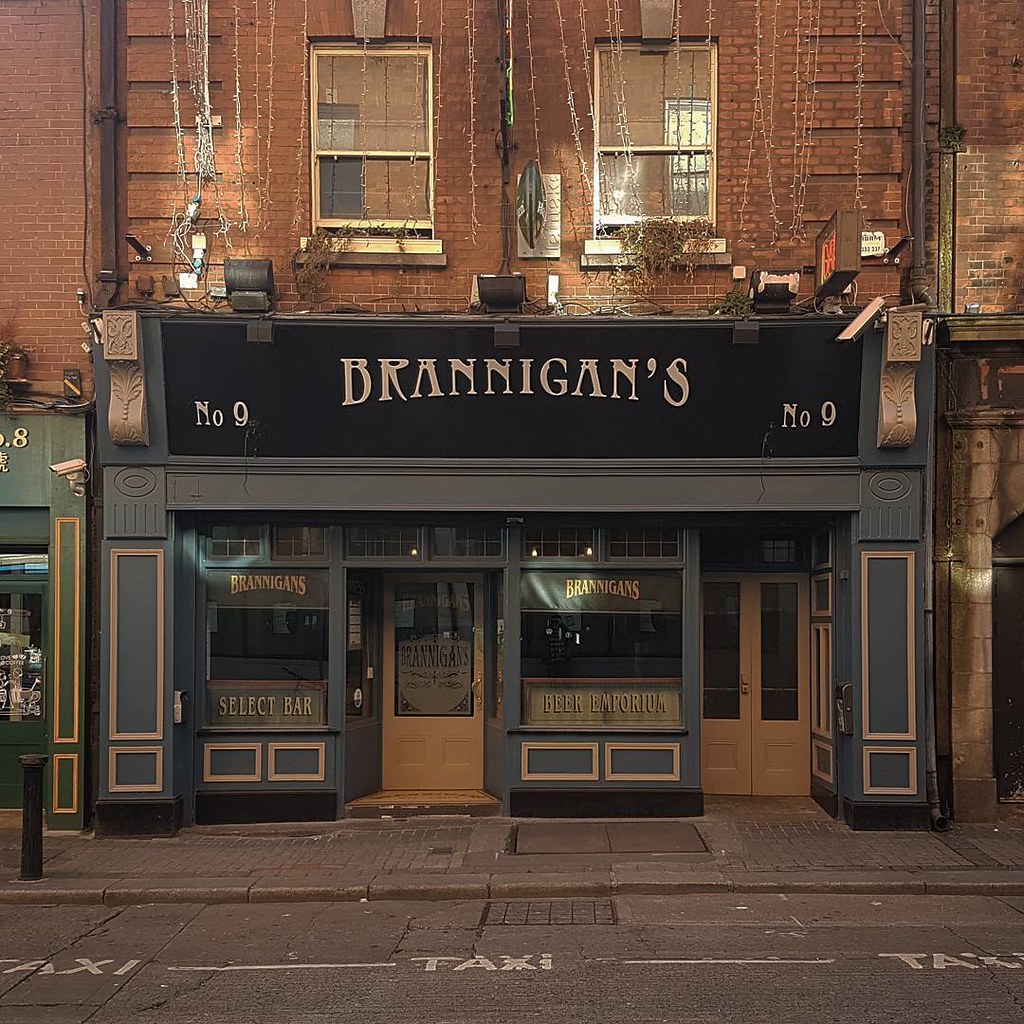
    Sitting in the shadows of the Pro-Cathedral and just off the main thoroughfare of O’Connell St. lies a boozer by the name of Brannigan’s. The pub, which is named after an infamous Dublin Gard who would offer his detainees the option of duking it out in lieu of traditional state-sanctioned justice, is one which evaded us for many years. I should, in this instance, start by commending Brannigan’s on their website, which gives a great history of the pub and its surrounding locality and is well worth a read. Over the years, we’d been in a mere handful of times, and we recently ventured in to remind ourselves of what the pub was like.

    Brannigan's

    A more effulgent shop compared to most of its contemporaries, the pub is no standard fare when it comes to drinking establishments across the city. Large gothic arches overhang the open space, which provides a good mixture of high and low seating. The seating itself is upholstered in vibrant stripes, which complement the light-coloured walls nicely. Flourishes of darker tones of wood add reminders of more prevailing décor throughout, and overall, we couldn’t argue with the pub’s aesthetic. The most notable feature of the pub, to us anyway, was the accumulation of portraits across the walls. Well-executed and striking painted and drawn images of famous faces provide fodder on subjects aplenty, from history to literature to sport and to music; all bases are covered.

    We last wandered in on a Saturday afternoon when the bar was busy, a steady stream of young sportswear buyers presumably replaced the steady stream of old dears from the nearby branch of Boyers, which had been repurposed as a sports megastore. We ordered our usual jars of stout from the bar, which was well decorated with surrendered foreign denominations. We were returned a few well-poured pints which were sank with zero complaints. We stayed for a few pints and conversed on subjects stemming from the aforementioned portraits, along with discussing the stairs down to the gents, which seemed to have been left out of the latest refurbishment.

    We’d certainly return to Brannigan’s at a moment’s notice. It’s a nice boozer with an easygoing pace about itself. Well recommended.

  • Devitt’s: Camden St.

    Devitt’s: Camden St.

    I wonder if you’ve ever found yourself, at some stage in your life, completely contradicting values that you hold dear for no other good reason than gut reaction? This happened to us a number of weeks ago when we wandered into the newly refurbished and newly managed Devitt’s of Camden St, which has instilled in us a sense of ambivalence that no other pub ever has.

    Devitt’s: Camden St.

    Devitt’s, as we knew it, was a family-run GAA pub which offered the normality of a local atmosphere amidst the madness of an ever-trendier Camden St. Aesthetically traditional, it was just another decent Dublin boozer – wooden flooring and carpet sectionalised areas for high and low seating while dividers aplenty broke up the bar and created nooks and crannies. It was a pub that was ageing nicely and the pick of Camden St. in our humble opinion.

    During 2017, we heard through various channels that the pub had been sold to a group and that the new owners were quick to put their money where their mouth is, deciding to finance a full refurbishment – news which we had received with much trepidation. Now this is where the contradictions start, so please bear with us. The new fit-out is fine – The exterior is immaculate; it would be easily argued that the façade of Devitt’s is the now finest pub frontage from The Grand Canal to Dame St. The interior is, for all intents and purposes, also fine– dark wood, wooden floor, drinking paraphernalia along the walls, it’s everything we look for and if it were a brand new pub that had been installed into a bare shell it would be fine. But it just didn’t sit right with us.

    We’ve been pondering this for the last few weeks, and our reasoning for not taking to this particular renovation is loosely described in the following sentiment. Essentially, Devitt’s new proprietors have thrown the baby out with the bathwater; they’ve literally taken an actual real-life old Irish pub and replaced it with a fit-out that’s designed to look like an actual real-life old Irish pub. They’ve gutted authentic, worn-in fixtures and fittings and replaced them with faux, pre-worn flatpack versions of themselves. It’s simply an act that we can neither abide nor understand. Imagine if The Stags Head or The Long Hall went for a psychedelic vibe in the 1960s, or went all disco ball in the 70s. What a disaster that would have been.

    But what’s done is done, and when we arrived, we had to reluctantly admit that the new owner’s investment was evidently paying off. An ironic version of a Ronan Keating tune was being blasted out by an energetic duo to a willing crowd, which was comprised of a younger demographic than one would have associated with Devitt’s previously. G&T bowls aplenty glistened in the shimmer of Christmas lighting, and the overall atmosphere in the pub sounded akin to that one would hear upon passing a temple bar pub on a Saturday afternoon. This wasn’t exactly to our taste.

    Determined not to be the grumpy aul bastards in the corner, we decided to focus on the positives. First of all, the pint – well poured and very well priced given the location, we couldn’t fault Devitt’s one iota here and can only urge them to keep up the good work in this regard. Secondly, we had to commend the inclusion of the pub’s GAA heritage within the décor, in particular the maintenance of the beloved porcelain GAA player figurines that any former patrons of Devitt’s will likely remember with much fondness.

    In our departure from the pub, we couldn’t help but ponder the future of the humble family-run Dublin boozer. With the way that economics seem to work in Ireland, the sad likelihood is that more and more cherished family-run pubs will fall afoul of wealthy groups and chains. We’d like to take this opportunity to issue a warning to these buyers. Pubs are our culture! Sterilising and homogenising them, depending on the flavour of the moment, for the purpose of profit, will only ultimately run them into the ground. Then they will render no use – economically or culturally. Look at the most popular of the pubs in Dublin. All of them are dozens or even decades old, with only minor aesthetic changes throughout the years.

    So if you do buy an ageing pub, hold off on that big refurbishment; a return on investment is only a century or two away.